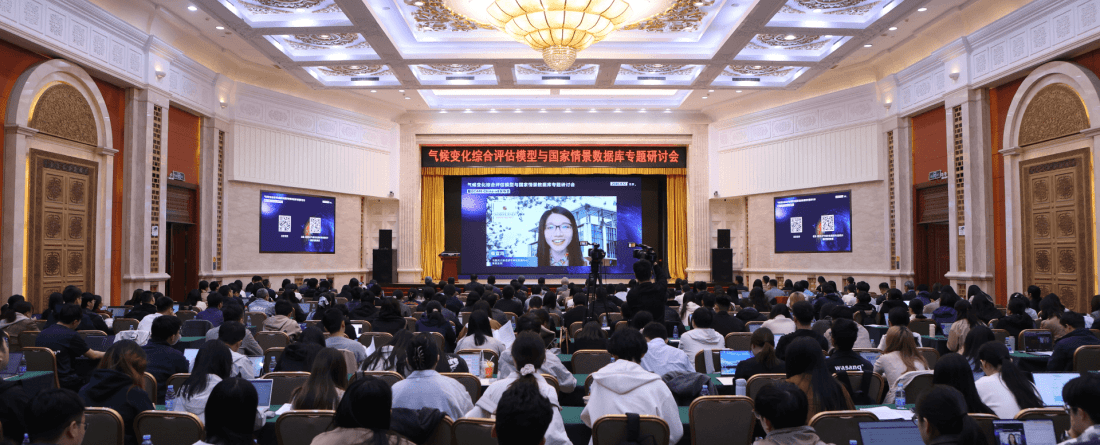
On April 12, 2026, the Center for Global Sustainability (CGS), in partnership with Peking University and Tsinghua University, celebrated the release of GCAM-China-v8 in Beijing. This updated version of GCAM-China represents another key milestone for the model since its initial open-source launch in March 2024. CGS Associate Director and China Program Co-Lead Ryna Cui provided opening remarks at the launch event to recognize and appreciate the dedicated, collaborative efforts by the joint U.S.-China modeling community, which advance modeling capabilities for assessing China’s energy, climate, and development strategies at the subnational levels.
As one of the core partners, CGS hosts the open-source GCAM-China on its GitHub website and has been closely involved in the maintenance, development, and application of the model. Since its first launch, GCAM-China has been downloaded more than 3,200 times, with a rapidly growing user community of nearly 900 participants. Open source has substantially accelerated the adoption, application, and advancement of GCAM-China through an active and thriving community, making it a successful model for other region-focused GCAM versions under development.
In her remarks, CGS Associate Director Ryna Cui shared CGS’s research on national climate ambition and pathways for key emitting countries and how these region-focused GCAM versions enhance the analyses. Beyond use of GCAM-China, the analyses use GCAM-USA-CGS to explicitly represent non-federal climate actions to assess high-ambition climate pathways in the U.S.
“High-quality national scenarios that represent diverse domestic policy contexts are largely missing for many countries around the world, which is a critical gap also called by the ongoing IPCC 7th assessment report,” Cui said. “Through long-term research partnerships, CGS has been making important contributions to advancing modeling capabilities and developing plausible, high-ambition country pathways that are relevant for policy discussions across countries.”
The updated version of GCAM-China-v8 includes several new features, ensuring consistency with the global version while enhancing its capabilities for China-specific applications. The new version includes harmonization with the latest global GCAM v8.2 framework, updating the base year to 2021, introducing a provincial-level water supply and demand module, and disaggregating coal power plants based on historical vintage years. Additionally, it expands analytical depth with technical pathway constraint cases and streamlines user workflows with newly developed auxiliary tools, such as automated scenario data processing into the standard IAMC format, a high-performance computing deployment toolkit, and a “1+N” regulatory measure toolbox.
“This latest version of GCAM-China is a testament to the power of free and open collaboration,” CGS Research Associate Andy Miller said. “There is clearly a large demand for a model that can comprehensively illustrate climate mitigation pathways for provinces within China, in the global context. Now that China’s government has announced its national 15th Five-Year-Plan, provinces are developing provincial versions to complement it, highlighting the need for studies to show the implications of varying targets.”
The launch convened a significant gathering, attracting over 300 attendees in person and more than 7,800 online viewers. This highlights the increasing dedication of the international scientific community to advancing climate research and policy development by IAMs. CGS will continue collaborating with its partners to improve upon GCAM-China, as well as the China Program’s entire research portfolio, to catalyze ambitious climate action in both the United States and China, as well as globally.