New Research Shows Why Where We Build Solar Matters

As solar development expanded across China, researchers noticed something unexpected in the landscapes where it was taking place. Some were becoming greener, but the diversity of birds living there was declining. School of Public Policy Professor and Roy F. Weston Chair in Natural Economics Lucy Qiu is among the researchers behind a new study published in Science, examining the effects of solar expansion policies on biodiversity.
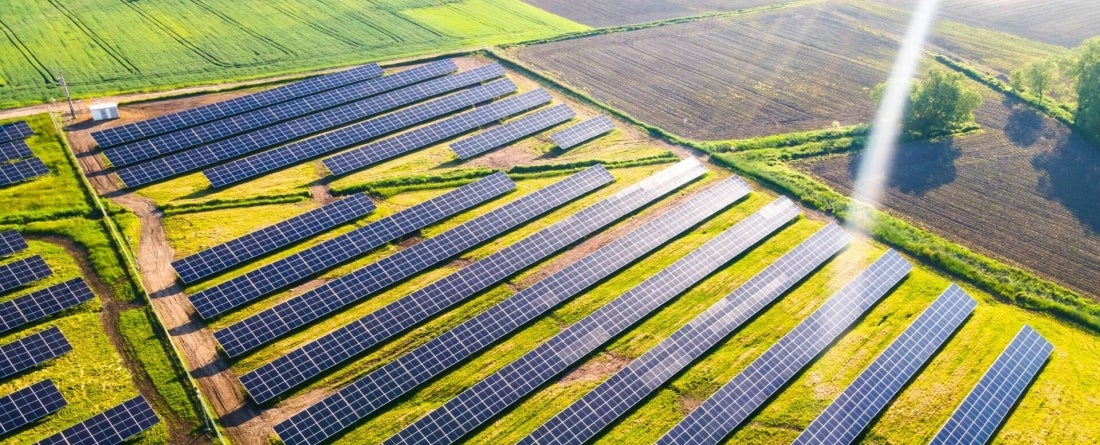
The study examined solar policies and bird diversity across 2,344 counties in China from 2014 to 2023. Qiu and her co-authors found that stronger policies promoting solar development were linked to declines in bird diversity largely because of changes in how land was used. Policies that encouraged solar expansion were associated with more conversion of cropland and grassland into developed areas, changing the habitats birds rely on.
The researchers also found that, in some places, the amount of vegetation increased even as the habitat became less ecologically diverse. “So more greenery does not always mean better habitat for wildlife,” said Qiu. The researchers call this phenomenon “inferior greening.” As native vegetation with a variety of plant species is removed for solar development, denser vegetation can grow beneath the panels. The result can be more vegetation, but less variety in the plants and other resources available to wildlife.
Most previous research has focused on what happens after solar farms are built. Qiu and her co-authors wanted to examine what happens earlier, when government policy helps determine where solar development occurs and how quickly it expands. They developed an index measuring the strength of solar policies at the provincial, municipal and county levels, then combined it with bird observation, environmental and socioeconomic data.
The impact on bird diversity also differed by location. Declines were concentrated outside China's arid Three-North region and in nondesert areas, where habitats tend to be more complex. Researchers did not find a significant effect on bird diversity in the desert regions they studied.
We need renewable energy to address climate change. But we should be smarter about where and how we build it.Lucy Qiu
For policymakers choosing locations for solar projects, Qiu said the findings show why sunlight and construction costs should not be the only considerations. Land use, vegetation, habitat quality and biodiversity should also factor into those decisions. When possible, projects should be directed toward already developed, degraded or other areas where they would create fewer ecological conflicts. Qiu emphasized that the findings are not an argument for slowing the transition to solar energy. “We need renewable energy to address climate change,” Qiu said. “But we should be smarter about where and how we build it.”
Governments could consider biodiversity earlier in renewable energy planning, before locations have been selected and projects are underway. Environmental reviews could look more broadly at habitat quality and landscape changes rather than focusing primarily on whether protected species are present.
The findings also raise questions about how the environmental impact of a project is measured after construction. If vegetation can increase while ecological diversity declines, measuring how much greenery remains may not tell the whole story. Qiu and her co-authors recommend that monitoring also account for biodiversity and the quality of the habitat that remains.
Although the study focused on China, the questions it raises are relevant anywhere governments are making decisions about the expansion of renewable energy. Decisions about where projects are built, what kind of land they replace and how the surrounding habitat is managed can shape the environmental impact of that transition. “The goal should be not just more solar,” said Qiu, “but better-sited and better-managed solar.”